


Ptosis Surgery – Improved Eyelid Opening
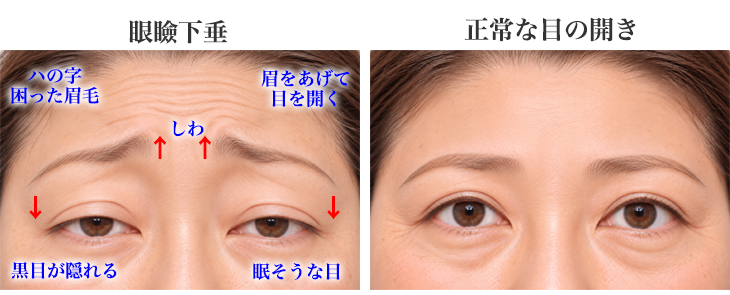
Ptosis (drooping eyelid) is a condition in which the upper eyelid cannot open fully due to stretching or loosening of the levator aponeurosis, the tendon-like tissue that connects the eyelid-lifting muscle (levator palpebrae superioris) to the tarsal plate, or weakening of the muscle itself. As the field of vision becomes restricted, patients may habitually raise their eyebrows to compensate. This can lead to forehead wrinkles, eye strain, chronic headaches, and stiffness in the neck and shoulders.
Among the causes mentioned above, aponeurotic ptosis, which results from stretching or loosening of the levator aponeurosis, is one of the most common types of acquired ptosis. In addition to aging, contributing factors may include prolonged contact lens wear, frequent use of double-eyelid glue or tape, and habitual eye rubbing due to allergies or other irritation. Prolonged smartphone use may also contribute to eye strain, although it is not an established direct cause of ptosis. Therefore, ptosis can affect not only middle-aged and older adults but also younger individuals.
In surgery for aponeurotic ptosis, an incision is made in the upper eyelid to shorten and secure the levator aponeurosis that has become stretched, thinned, or loosened. This allows the movement of the eyelid-lifting muscle to be effectively transmitted to the tarsal plate, improving eyelid opening. As a result, symptoms such as eye strain, headaches, neck and shoulder stiffness, and forehead wrinkles may also be reduced. A double-eyelid crease can be created during the same procedure if desired. The results are generally long-lasting, and this procedure can also be effective for severe cases of aponeurotic ptosis. When the eyelid-lifting muscle itself is significantly weakened, a different procedure called **frontalis sling surgery** may be performed. This involves using a tendon or fascia graft from another part of the body to connect the eyelid to the forehead muscle, allowing the forehead muscle to help lift the eyelid.
Recommended For
✓ Those who are concerned about tired or sleepy-looking eyes
✓ Those whose upper eyelids cover part of the pupils, restricting their field of vision
✓ Those who develop forehead wrinkles from constantly raising their eyebrows to open their eyes
✓ Those who are concerned about an aged appearance due to an increased distance between the eyes and eyebrows
✓ Those who tend to frown or develop a worried expression with drooping outer eyebrows
✓ Those who suffer from chronic eye strain, headaches, or neck and shoulder stiffness
| Ptosis Surgery | |
|---|---|
| Ptosis Surgery | ¥660,000 |
| Ptosis Surgery + ROOF Reduction | ¥770,000 |

Swelling
Typically peaks 2–3 days after surgery. Most swelling subsides within approximately 2 weeks, with overall recovery taking about 1 month. Final results are generally seen after approximately 3 months.
Bruising
If bruising occurs, it usually resolves within 1–2 weeks. Scarring: Redness and firmness around the incision gradually improve over several months, although some scarring may remain.
Other Risks
Warmth around the surgical site, asymmetry, redness of the whites of the eyes, wound separation, and infection.
*The severity of symptoms and recovery time may vary from person to person.*

