


Transconjunctival Fat Removal (Under-Eye Bags)
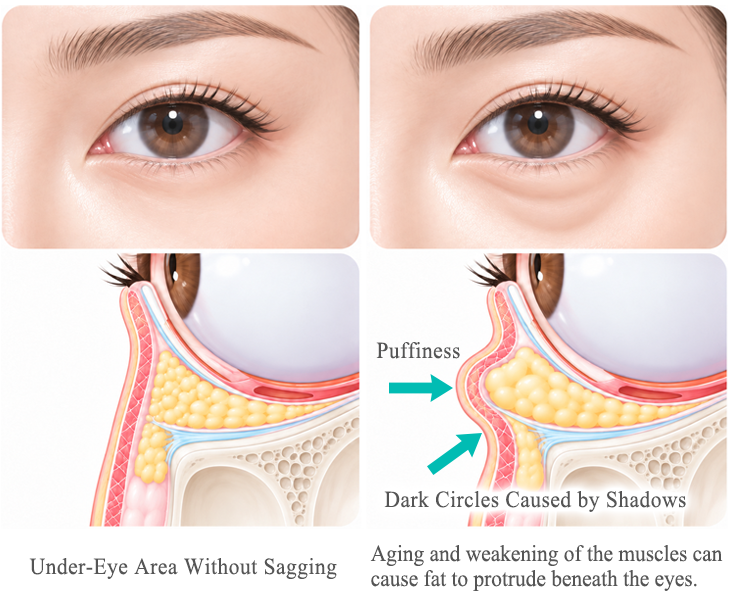
Dark circles under the eyes can have various causes. One common cause is puffiness beneath the eyes, which creates shadows and makes the under-eye area appear darker. Transconjunctival fat removal is a procedure that removes excess orbital fat responsible for this puffiness, helping to improve the appearance of under-eye bags. Changes in tissue and bone structure associated with aging can cause orbital fat to protrude forward. This puffiness may cast shadows beneath the eyes, making dark circles more noticeable and giving the face a tired or older appearance.
In transconjunctival fat removal, an incision is made on the inner surface of the lower eyelid to remove protruding orbital fat. Because no incision is made on the outer skin, there is no visible external scar, and the recovery period is generally relatively short.
By reducing puffiness beneath the eyes, this procedure can make shadow-related dark circles less noticeable and help create a brighter, more natural-looking eye area. It is suitable for patients whose dark circles are caused by protruding orbital fat. However, if sagging skin or hollowness beneath the eyes is also a concern, other procedures, such as the Hamra or reverse Hamra technique, may be more appropriate.
Recommended For
✓ Those concerned about puffiness or dark circles beneath the eyes
✓ Those who look tired due to shadows under the eyes
✓ Those who find it difficult to conceal dark circles with makeup
✓ Those who prefer a procedure without visible scars on the skin
| Dark Circle & Eye Bag Removal | |
|---|---|
| Transconjunctival Fat Removal | ¥275,000 |

Possible side effects and risks include swelling, internal bleeding, asymmetry, unevenness, puffiness, eye redness, and infection. Results and recovery times vary from person to person.
Hamra Technique
Transcutaneous and Transconjunctival Approaches
Improvement of Under-Eye Dark Circles, Sagging, Hollowness, and Fine Lines.
The Hamra technique is a surgical procedure designed to improve under-eye dark circles, sagging, hollowness, and fine lines.
As we age, changes in the surrounding tissues and bone structure may cause orbital fat beneath the eyes to protrude forward. This can create puffiness and hollowness under the eyes, making shadows more noticeable.
In the Hamra technique, protruding orbital fat is repositioned and secured in hollow areas beneath the eyes rather than removed, helping to smooth out uneven contours under the eyes.
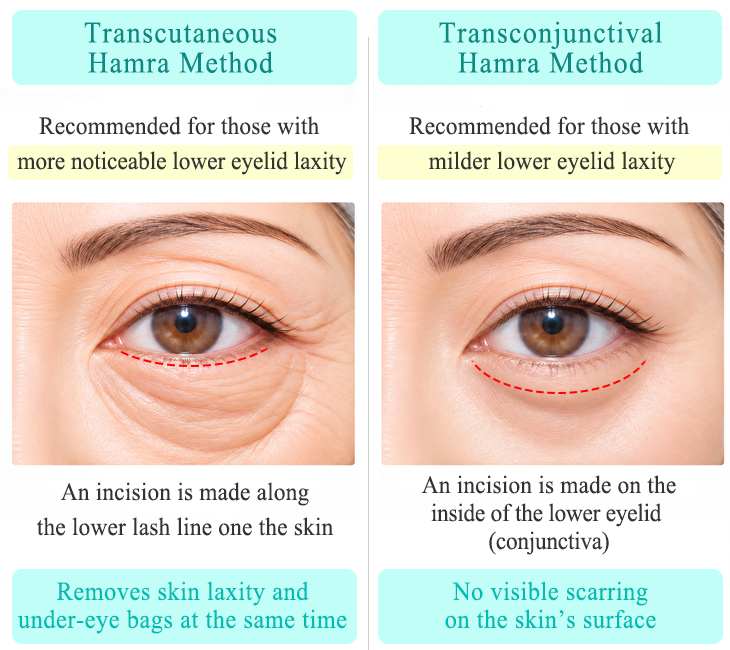
The Hamra technique includes two approaches: the transcutaneous approach (external Hamra), which involves an incision through the skin, and the transconjunctival approach (internal Hamra), which involves an incision on the inner surface of the lower eyelid. The most appropriate approach is selected based on the degree of under-eye puffiness, skin laxity, and other individual factors.
Transcutaneous Hamra Technique (External Hamra)
The transcutaneous Hamra technique involves making an incision along the lower eyelashes and repositioning protruding orbital fat into hollow areas beneath the eyes, where it is secured in place. Excess skin can also be removed when necessary, allowing the procedure to address under-eye dark circles, puffiness, sagging, hollowness, and fine lines. This approach is particularly suitable for patients with significant skin laxity in addition to under-eye bags and hollowness. Because the incision is made along the lower lash line, the scar is generally relatively inconspicuous. Postoperative redness typically fades gradually over approximately three to six months, although some scarring may remain.
Recommended For
✓ Patients with noticeable under-eye puffiness, hollowness, and skin sagging, particularly age-related changes
✓ Patients who want to improve both dark circles and fine lines beneath the eyes
| Under-Eye Treatment for Dark Circles, Bags, Sagging, Hollows, and Wrinkles | |
|---|---|
| Transcutaneous Hamra Method | ¥660,000 |
Possible risks and side effects include swelling, bruising, internal bleeding, bleeding, pain, redness, asymmetry, infection, bloodshot eyes, ectropion (outward turning of the lower eyelid), scarring, pigmentation changes, lower eyelid retraction, dry eyes, excessive tearing, allergic reactions, and pulling of the lower eyelid. Compared with the internal Hamra technique, swelling and bruising tend to be more pronounced.
Transconjunctival Hamra Technique (Internal Hamra)
The transconjunctival Hamra technique involves making an incision on the inner surface of the lower eyelid (conjunctival side) and repositioning and securing protruding orbital fat in hollow areas beneath the eyes. This procedure addresses both under-eye puffiness and hollowness at the same time.
One of the main advantages of this technique is that no incision is made on the outer skin, leaving no visible external incision scar. It is particularly suitable for patients with relatively little skin sagging who are concerned about under-eye puffiness or hollowness.
In cases where transconjunctival fat removal alone may leave hollowness or make it more noticeable, the transconjunctival Hamra technique may be a more appropriate option.
Recommended For
✓ Patients with both under-eye puffiness and hollowness (dark circles).
✓ Patients who wish to avoid visible external scars.
✓ Patients whose under-eye hollowness may become more noticeable with fat removal alone.
✓ Patients with minimal lower eyelid skin sagging.
| Under-Eye Treatment for Dark Circles, Bags, Sagging, and Hollows | |
|---|---|
| Transconjunctival Hamra Method | ¥550,000 |
Possible risks and side effects include swelling, puffiness, bruising, bleeding, pain, entropion (inward turning of the eyelid), ectropion (outward turning of the eyelid), chemosis (conjunctival swelling), eye redness, infection, dry eyes, uneven contours, asymmetry, lumps, temporary blurred vision, and, in rare cases, double vision (diplopia) or visual impairment.

